Holp bills on conversations, not on messages or users. This guide explains what that means in practice, how to read your usage, and how to avoid the two things people get caught out by: running out mid-month, and paying for capacity they never use.
Where to find it
Click Plan & usage at the bottom of the left-hand menu.
Reading the screen
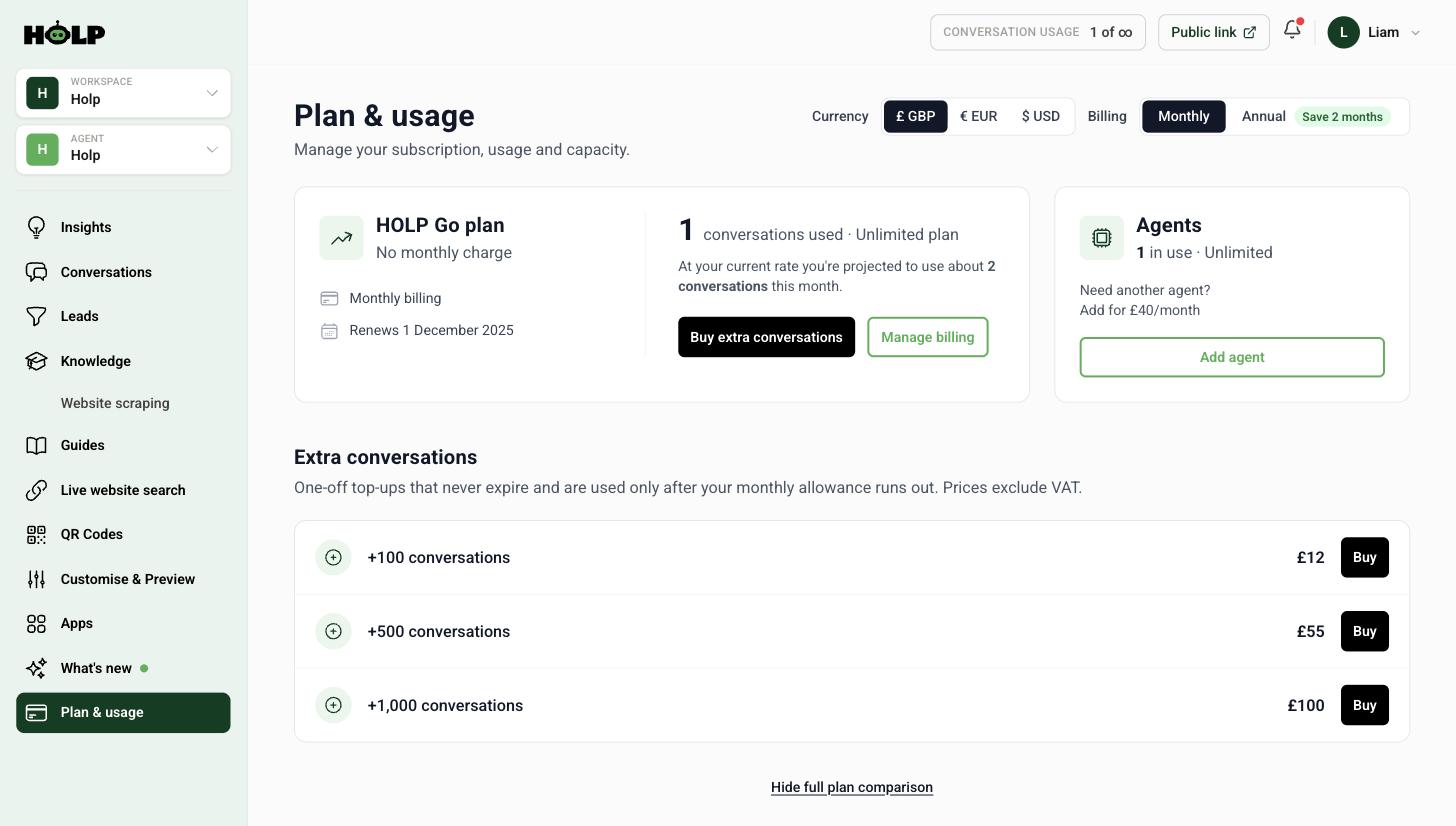
The left panel shows your current plan, whether you are billed monthly or annually, and when it renews. Beside it sits your usage — conversations used so far, and a projection of where you will end the month at your current rate.
That projection is the number to look at. It is what tells you, on the 10th, whether you are heading for trouble on the 25th.
The right panel shows agents — how many assistants you have in use, and what an additional one costs.
What counts as a conversation
A conversation is one chat session with a visitor, not one message. Someone who asks six questions in a row is one conversation, not six.
This matters for how you think about your assistant. A visitor having a long, useful exchange costs you the same as one who asks a single question and leaves — so there is no reason to discourage depth. Encourage follow-up questions; they are free and they are where the value is.
Conversations from every route count together: your embedded widget, your public link, and QR codes.
Choosing a plan
Plans are tiered by conversations per month, from a starter tier up to enterprise volumes with custom limits. You can switch between monthly and annual billing, with a discount for paying annually, and view prices in pounds, euros or dollars.
Prices exclude VAT, which is added at checkout.
How to pick one
Do not guess from your website traffic — the ratio of visitors to conversations varies enormously between sites. Start on a plan you are comfortable with, run for a month, and look at the actual number. It is far easier to move up once you have real data than to predict it in advance.
If you are already running, take last month’s conversation count from Insights and add headroom for growth and for seasonal peaks.
Extra conversations
If you run short, you can buy one-off top-ups in blocks. Two things make these more useful than they first appear:
- They never expire. Unused top-up conversations stay in your account.
- They are only used after your monthly allowance runs out. They sit underneath as a reserve rather than being spent first.
That makes a top-up a sensible insurance policy for a known peak — a campaign, an open day, a seasonal rush — without permanently moving to a larger plan.
Top up or upgrade?
A rough rule: if you go over occasionally, top up. If you go over most months, upgrade — a bigger plan is cheaper per conversation than repeated top-ups, and you stop having to think about it.
Adding another assistant
Each additional agent is charged separately, with the cost shown on the same screen.
You need a second assistant when you genuinely need separate knowledge, branding or conversation history — two distinct brands, two venues with different information, or a public assistant plus an internal one. You do not need one just because you have two audiences; one assistant with good knowledge usually serves both.
Managing billing
Manage billing opens the billing portal, where you can update your payment method, download invoices and change or cancel your plan. Changes can be made at any time.
Avoiding an unpleasant surprise
- Check the projection mid-month. It is the early warning, and it is on the screen you visit least.
- Buy top-ups before a known peak, not during it.
- Watch for a spike in conversations that does not match a rise in enquiries. If usage jumps and nothing else did, look at Conversations to see what is driving it.
- Keep the card on the account current. A failed payment is a needless way to lose service.
A worked example: working out what you need
A visitor attraction has 40,000 website visits a month and no idea how that translates into conversations. Rather than guess, they start on a mid-sized plan and watch.
Month one comes in at 380 conversations — roughly one conversation per hundred visits, which is a fairly typical ratio for a site where people mostly want opening times and tickets. Month two is 420. Then August arrives and they hit 900.
The right response is not to move permanently onto a plan sized for August. It is to stay on the plan that suits ten months of the year and buy a block of extra conversations before the summer. The top-ups do not expire, so anything unused rolls into next summer.
The wrong response — and the common one — is to notice on the 20th of August that the allowance has gone, panic, and upgrade mid-peak.
Watch the ratio, not the total
The number worth tracking month to month is not your conversation count on its own. It is conversations relative to what caused them.
If conversations rise because traffic rose, that is growth and you plan for it. If conversations rise while traffic is flat, something changed — a new page confusing people, a broken form pushing people to chat, a price change generating questions. That is worth investigating in Conversations before you spend money on capacity.
Falling conversations with steady traffic is worth investigating too. The usual cause is the widget having quietly stopped appearing after a site update.
Seasonal planning
Most organisations have a shape to their year. Attractions peak in the school holidays, education peaks around results day and clearing, retail peaks in November and December, membership bodies peak at renewal.
Look at last year’s pattern in Insights, find your two or three peak months, and buy top-ups a month before each. Fifteen minutes of planning removes the possibility of running out at your busiest moment.
Getting the most from the allowance you have
Because a conversation is a session rather than a message, the way to get value is depth, not restraint:
- Encourage follow-up questions. They cost nothing and they are where visitors get properly helped.
- Do not gate the widget behind a form. Gating reduces conversations, which sounds like a saving and is actually a loss of every enquiry you were not going to convert anyway.
- Fix repeated questions with knowledge rather than letting them become leads that cost staff time.
- Do check for unusual spikes. A sudden jump with no obvious cause is worth a look.
Frequently asked questions
What counts as one conversation?
One chat session with a visitor, however many questions they ask within it. Six questions in one session is one conversation.
Do conversations from QR codes and public links count?
Yes. Every route into your assistant counts towards the same allowance.
What happens if I run out mid-month?
Buy a block of extra conversations. They never expire and are used only after your monthly allowance runs out.
Should I top up or move to a bigger plan?
Top up if you exceed your allowance occasionally. Upgrade if it happens most months — it works out cheaper per conversation.
Can I pay annually?
Yes, and annual billing is discounted compared with monthly. You can switch using the billing toggle on the Plan and usage screen.
Do prices include VAT?
No. Prices exclude VAT, which is added at checkout.
When do I need a second assistant?
When you need genuinely separate knowledge, branding or conversation history — two brands, two venues, or a public and an internal assistant. Additional agents are charged separately.
Can I cancel or change plan at any time?
Yes, from the billing portal via Manage billing.
Where to go next
More from Holp
- What does a chatbot cost? — every pricing model, and the costs nobody lists
- Best AI agents for customer service in 2026 — how the options compare, honestly
- All resources — tools, comparisons and platform guides in one place